This changes the monitor selection used when restoring a persisted
window position.

Currently, `egui-winit` picks a monitor by checking whether the saved
window position fits inside a loose monitor range. This can choose the
wrong monitor when a saved window rectangle slightly overlaps another
monitor.

My failure case was on Windows with two monitors:
- primary monitor on the right
- secondary monitor on the left
- window maximized on the primary monitor
- persisted outer position was slightly negative, e.g. `x = -8`, because
of the invisible window border

That position matched both monitor ranges, so the restored maximized
window could
open on the secondary monitor instead of the primary one.

This PR picks the monitor with the largest overlap with the saved window
rectangle instead.

Related note: probably the best solution would be to save the normal
window position when maximized, so that when unmaximizing, the window
would get restored to the previous state. It's mentioned in this comment
https://github.com/emilk/egui/issues/3494#issuecomment-1986985211. I
tried doing that in
[fix-windows-maximized-restore-placement](https://github.com/YelovSK/egui/tree/fix-windows-maximized-restore-placement),
and it works, but it requires adding windows-sys as a dependency to call
a relevant winapi, so that's probably not the right solution. Winit
doesn't seem to provide an API that would return this information.

* [x] I have followed the instructions in the PR template

---------

Co-authored-by: Emil Ernerfeldt <emil.ernerfeldt@gmail.com>
## What
Adds a way for apps to push an RGBA bitmap as the OS cursor — the
missing companion to `Context::set_cursor_icon`. The integration
translates it into a real `winit::CustomCursor`, so the cursor is drawn
by the compositor and can extend past the egui window edge like any
native cursor.
## Why
Apps with custom-shaped windows (Winamp-style skins, themed launchers,
kiosk apps) currently have no clean way to display a custom cursor:
- `CursorIcon` is limited to the standard system enum.
- Painting the cursor sprite via `egui::Painter` works inside the canvas
but gets clipped at the window edge — the bottom/right of the cursor
disappears the moment the pointer is near the boundary, and there's no
way to render onto the desktop area exposed by a
transparent/region-shaped window.
`winit` 0.30+ already supports `CustomCursor::from_rgba` +
`ActiveEventLoop::create_custom_cursor`, but `egui-winit` doesn't
surface it. This PR exposes it through egui.
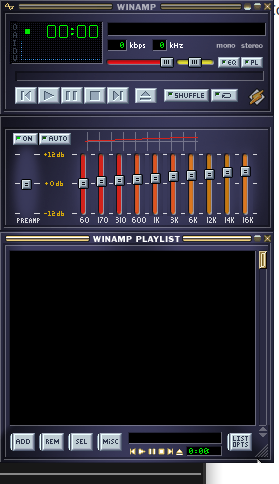
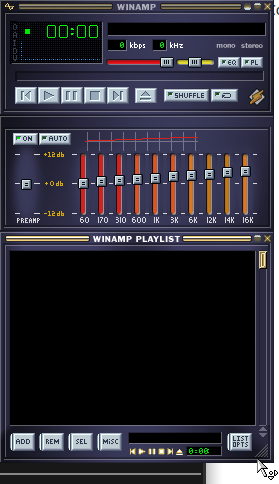
### Visual demonstration
Driving use case: a Winamp WSZ skin player
([all3f0r1/oneamp](https://github.com/all3f0r1/oneamp)) with a
transparent + region-shaped window where the skin ships its own `.cur`
files. The bottom-right corner of the playlist exposes the resize cursor
— notice how it gets clipped at the window edge in the painter-based
approach.
| Before (cursor painted via `egui::Painter`) | After (cursor pushed via
`set_cursor_image`) |
| --- | --- |
| 
| 
|
## API
```rust
// new in egui::data::output
pub struct CustomCursorImage {
pub rgba: std::sync::Arc<[u8]>,
pub size: [u16; 2], // matches winit's u16 to avoid lossy casts
pub hotspot: [u16; 2],
}
// new field on PlatformOutput (skipped from serde — ephemeral)
pub cursor_image: Option<CustomCursorImage>,
// new method on Context
ctx.set_cursor_image(Some(image)); // overrides cursor_icon for this frame
ctx.set_cursor_image(None); // revert to cursor_icon
```
`Arc<[u8]>` is intentional: the integration dedupes by `Arc::as_ptr`, so
reusing the same Arc across frames means the bitmap is only uploaded to
the OS once per skin, not once per frame.
## Integration changes
- `egui_winit::State::handle_platform_output_with_event_loop(window,
Option<&ActiveEventLoop>, ...)` is a new method that threads the active
event loop so it can call `event_loop.create_custom_cursor(...)`.
- The legacy `handle_platform_output(window, ...)` delegates with `None`
and silently drops `cursor_image`. **No existing callers break.**
- The icon and bitmap paths are unified in a private `apply_cursor`. The
no-flicker dedupe of the old `set_cursor_icon` is preserved on both
paths.
- If `CustomCursor::from_rgba` rejects the bitmap (bad dimensions,
hotspot OOB, etc.), we log a warning and fall back to the icon path.
- eframe's wgpu + glow integrations thread `&ActiveEventLoop` through
`run_ui_and_paint` (glow already had it; wgpu needed one extra
parameter) and call the new method.
- Immediate viewports keep the old path because they're invoked from a
`Context` callback that doesn't have an event loop reference. Custom
cursors are a no-op in immediate viewports — acceptable since they're a
niche path.
## Fallback semantics
| backend / context | what happens |
|--------------------------------|-------------------------------|
| eframe wgpu/glow main viewport | bitmap displayed via OS |
| eframe immediate viewport | falls back to `cursor_icon` |
| eframe web | falls back to `cursor_icon` |
| custom integrations not opted in | falls back to `cursor_icon` |
| `from_rgba` returns `BadImage` | warning + falls back to icon |
## Verification
- `cargo fmt --all -- --check` ✅
- `cargo clippy -p egui -p egui-winit -p eframe --all-targets
--all-features -- -D warnings` ✅
- `cargo doc --lib --no-deps -p egui -p egui-winit -p eframe
--all-features` ✅
- `cargo check -p egui --no-default-features --features serde` ✅
(validates the `serde(skip)` on `cursor_image`)
- Interactive validation on Linux/Wayland with the OneAmp WSZ skin
player — see screenshots above.
I haven't run the full snapshot test suite (`scripts/check.sh`) because
we're on Linux and the snapshots are macOS-rendered — happy to run it if
you'd like.
## Notes
Drafted per the contributing guide ("open a draft PR, you may get
helpful feedback early"). Open to design feedback on:
1. Whether `CustomCursorImage` should live in `egui::viewport` rather
than `egui::data::output`.
2. Whether the legacy `handle_platform_output` should grow `event_loop`
directly (breaking) instead of getting a sibling method (non-breaking,
what I did).
3. Whether to also wire it through eframe-web (probably not —
`wasm-bindgen-cursor` would need its own path).
---------
Co-authored-by: Claude Opus 4.7 (1M context) <noreply@anthropic.com>
This lets you start up the test app from within the test itself, which
can be very useful when you have a specific test scenario set up that
you need to debug.

### Related
* Previous attempt: https://github.com/emilk/egui/pull/5418

### macOS
On macOS, you may only run UIs on the main loop, so you need a few
additional steps. Not ideal, but works!


```diff
diff --git a/crates/egui_demo_app/Cargo.toml b/crates/egui_demo_app/Cargo.toml
index f9a153268..4e0cc14ee 100644
--- a/crates/egui_demo_app/Cargo.toml
+++ b/crates/egui_demo_app/Cargo.toml
@@ -84,3 +84,7 @@ web-sys.workspace = true

 [dev-dependencies]
 egui_kittest = { workspace = true, features = ["eframe", "snapshot", "wgpu"] }
+
+[[test]]
+name = "test_demo_app"
+harness = false
diff --git a/crates/egui_demo_app/tests/test_demo_app.rs b/crates/egui_demo_app/tests/test_demo_app.rs
index e083c8455..7ad9ed516 100644
--- a/crates/egui_demo_app/tests/test_demo_app.rs
+++ b/crates/egui_demo_app/tests/test_demo_app.rs
@@ -4,7 +4,10 @@ use egui_demo_app::{Anchor, WrapApp};
 use egui_kittest::SnapshotResults;
 use egui_kittest::kittest::Queryable as _;

-#[test]
+fn main() {
+    test_demo_app();
+}
+
 fn test_demo_app() {
     let mut harness = egui_kittest::Harness::builder()
         .with_size(Vec2::new(900.0, 600.0))
@@ -73,5 +76,8 @@ fn test_demo_app() {
         harness.run_steps(4);

         results.add(harness.try_snapshot(anchor.to_string()));
+
+        harness.spawn_eframe_app();
+        break;
     }
 }
```
* Closes N/A
* Partially replaces #7983
* Related: #8045
* [x] I have followed the instructions in the PR template

## Details

In #7983, I modified `Memory::request_focus` to interrupt any ongoing
IME composition. This fixed a bug where clicking inside an already
focused `TextEdit` failed to cancel the active composition, resulting in
duplicated text:

https://github.com/emilk/egui/pull/8045#issuecomment-4193310616

To avoid introducing API changes in that PR, I ensured the IME state was
reset by forcing `PlatformOutput::ime` to `None` for at least one frame.
While this works well on desktop platforms, it causes virtual keyboard
flickering on the web:

https://github.com/emilk/egui/pull/8045#issuecomment-4193035008

In this PR, I delegate the responsibility for handling IME composition
interruptions to integrations, allowing each integration to decide how
to interrupt compositions in a flexible manner.

### The new field `should_interrupt_composition` on `IMEOutput`.

Instead of introducing a new `OutputCommand` variant, this PR adds a new
field `should_interrupt_composition` to `IMEOutput`.

Interrupting an active composition is only meaningful when IME remains
allowed. If IME should be disabled altogether, `PlatformOutput::ime` can
simply be set to `None`.
Given this, IMO, it is more appropriate to attach the interrupt signal
to `IMEOutput` (i.e., the type of `PlatformOutput::ime`).
<!--
Please read the "Making a PR" section of
[`CONTRIBUTING.md`](https://github.com/emilk/egui/blob/main/CONTRIBUTING.md)
before opening a Pull Request!
* Keep your PR:s small and focused.
* The PR title is what ends up in the changelog, so make it descriptive!
* If applicable, add a screenshot or gif.
* If it is a non-trivial addition, consider adding a demo for it to
`egui_demo_lib`, or a new example.
* Do NOT open PR:s from your `master` branch, as that makes it hard for
maintainers to test and add commits to your PR.
* Remember to run `cargo fmt` and `cargo clippy`.
* Open the PR as a draft until you have self-reviewed it and run
`./scripts/check.sh`.
* When you have addressed a PR comment, mark it as resolved.
Please be patient! I will review your PR, but my time is limited!
-->
* Depends on #7967
* Closes#7485
* Should fix#7906 (This issue doesn't seem to have been resolved, but
the author closed it; I personally don't have the environment to verify
whether it is fixed.)
* Replaces #4137, #4896, and partially #7810
* [x] I have followed the instructions in the PR template
This PR started as a fix for #7485, but has since evolved into a broader
rewrite of IME-related logic.
## Overview
This PR primarily introduces a new public method, `owns_ime_events`, on
[`Memory`], and refactors parts of [`TextEdit`] to integrate with it.
Previously, each [`TextEdit`] widget independently determined whether to
handle IME events and stored its own IME-related state. This approach
made ownership-handling fragmented and was therefore error-prone.
With this PR:
- IME event ownership is centralized, ensuring that at most a single
widget owns IME events per frame.
- [`PlatformOutput`]'s `ime` field can be set to `None` for at least one
frame when IME composition is interrupted, allowing the IME to be
properly dismissed.
## Details
Two new public methods are introduced on [`Memory`]:
- `fn owns_ime_events(&self, id: Id) -> bool`: check IME event ownership
for the current frame for the widget with the given `id`.
- `fn interrupt_ime(&mut self)`: interrupt the current IME composition,
if any.
Since the newly added methods on [`Memory`] are public, other widgets
can also participate in IME handling without risking ownership conflicts
of IME events.
I also added an internal (`pub(crate)`) field on [`TextEditState`],
called `cursor_purpose`, to distinguish the role of the [`TextEdit`]
cursor.
Additionally, `egui::ImeEvent::Enabled` and `egui::ImeEvent::Disabled`
have been removed, as they are no longer used anywhere.
## Demonstrations
### Windows: The Korean IME text duplication bug fixed in #4137 does not
reappear.
<table>
<thead>
<tr>
<th></th>
<th>With this PR</th>
<th>Without this PR</th>
</tr>
</thead>
<tbody>
<tr>
<th>Behavior</th>
<td>Correct (no regression)</td>
<td>Correct</td>
</tr>
<tr>
<th>Screencast</th>
<td>

</td>
<td>

</td>
</tr>
</tbody>
</table>
### Windows: Chinese and Japanese IMEs now behave more consistently with
the Korean IME in similar scenarios.
This change does not matter much, as composition is rarely interrupted
mid-process with these IMEs in typical usage.
<table>
<thead>
<tr>
<th></th>
<th>With this PR</th>
<th>Without this PR</th>
</tr>
</thead>
<tbody>
<tr>
<th>Behavior</th>
<td>Composition can be interrupted by clicking (like Korean IMEs)</td>
<td>Composition can not interrupted by clicking</td>
</tr>
<tr>
<th>Screencast (Builtin Chinese IME)</th>
<td>

</td>
<td>

</td>
</tr>
<tr>
<th>Screencast (Builtin Japanese IME)</th>
<td>

</td>
<td>

</td>
</tr>
</tbody>
</table>
### macOS: was buggy, still buggy
Likely due to this upstream bug in `winit`:
https://github.com/rust-windowing/winit/issues/4432
Once `winit` is updated to a version that includes the fix, the behavior
should become correct with this PR.
<table>
<thead>
<tr>
<th></th>
<th>With this PR</th>
<th>Without this PR</th>
</tr>
</thead>
<tbody>
<tr>
<th>Behavior</th>
<td>Buggy as before</td>
<td>Buggy: Characters are duplicated</td>
</tr>
<tr>
<th>Screencast</th>
<td>

</td>
<td>

</td>
</tr>
</tbody>
</table>
### Wayland + iBus: Korean IME duplication bug fixed
<table>
<thead>
<tr>
<th></th>
<th>With this PR</th>
<th>Without this PR</th>
</tr>
</thead>
<tbody>
<tr>
<th>Behavior</th>
<td>Correct</td>
<td>Buggy: Characters are duplicated</td>
</tr>
<tr>
<th>Screencast</th>
<td>

</td>
<td>

</td>
</tr>
</tbody>
</table>
### Wayland + iBus: #7485 is fixed
<table>
<thead>
<tr>
<th></th>
<th>With this PR</th>
<th>Without this PR</th>
</tr>
</thead>
<tbody>
<tr>
<th>Behavior</th>
<td>Correct</td>
<td>Buggy: Only a single ASCII character can be typed after
<code>TextEdit</code> is focused</td>
</tr>
<tr>
<th>Screencast</th>
<td>

</td>
<td>

</td>
</tr>
</tbody>
</table>
### Wayland + iBus: selection is also not broken
This PR does not reintroduce the selection bug fixed in #7973.
<table>
<thead>
<tr>
<th></th>
<th>With this PR</th>
</tr>
</thead>
<tbody>
<tr>
<th>Behavior</th>
<td>Correct</td>
</tr>
<tr>
<th>Screencast</th>
<td>

</td>
</tr>
</tbody>
</table>
### X11 + Fcitx5: IME composition can be interrupted
But due to #7975, the experience is still subpar. (Uncommitted text is
lost after interruption.)
<table>
<thead>
<tr>
<th></th>
<th>With this PR</th>
<th>Without this PR</th>
</tr>
</thead>
<tbody>
<tr>
<th>Screencast</th>
<td>

</td>
<td>

</td>
</tr>
</tbody>
</table>
[`Memory`]: https://docs.rs/egui/latest/egui/struct.Memory.html
[`TextEdit`]:
https://docs.rs/egui/latest/egui/widgets/text_edit/struct.TextEdit.html
[`PlatformOutput`]:
https://docs.rs/egui/latest/egui/struct.PlatformOutput.html
[`TextEditState`]:
https://docs.rs/egui/latest/egui/widgets/text_edit/struct.TextEditState.html
<!--
Please read the "Making a PR" section of
[`CONTRIBUTING.md`](https://github.com/emilk/egui/blob/main/CONTRIBUTING.md)
before opening a Pull Request!

* Keep your PR:s small and focused.
* The PR title is what ends up in the changelog, so make it descriptive!
* If applicable, add a screenshot or gif.
* If it is a non-trivial addition, consider adding a demo for it to
`egui_demo_lib`, or a new example.
* Do NOT open PR:s from your `master` branch, as that makes it hard for
maintainers to test and add commits to your PR.
* Remember to run `cargo fmt` and `cargo clippy`.
* Open the PR as a draft until you have self-reviewed it and run
`./scripts/check.sh`.
* When you have addressed a PR comment, mark it as resolved.

Please be patient! I will review your PR, but my time is limited!
-->

* [X] I have followed the instructions in the PR template

Quick fix -- when the arboard and smithay features are both enabled,
Clipboard::get returns early if it can't find a smithay clipboard. This
PR just allows fallback to arboard instead of early-returning.

---------

Co-authored-by: Emil Ernerfeldt <emil.ernerfeldt@gmail.com>
<!--
Please read the "Making a PR" section of
[`CONTRIBUTING.md`](https://github.com/emilk/egui/blob/main/CONTRIBUTING.md)
before opening a Pull Request!
* Keep your PR:s small and focused.
* The PR title is what ends up in the changelog, so make it descriptive!
* If applicable, add a screenshot or gif.
* If it is a non-trivial addition, consider adding a demo for it to
`egui_demo_lib`, or a new example.
* Do NOT open PR:s from your `master` branch, as that makes it hard for
maintainers to test and add commits to your PR.
* Remember to run `cargo fmt` and `cargo clippy`.
* Open the PR as a draft until you have self-reviewed it and run
`./scripts/check.sh`.
* When you have addressed a PR comment, mark it as resolved.
Please be patient! I will review your PR, but my time is limited!
-->
* Closes#7809
* Closes#7876
* Closes#7908
* Supersedes #7877
* Supersedes #7898
* The author of the PR above replaced it with #7914, which additionally
fixes another IME issue. I believe that fix deserves a separate PR.
* Reverts #4794
* [x] I have followed the instructions in the PR template
This approach is better than #7898 (#7914) because it correctly handles
all three major IME types (Chinese, Japanese, and Korean) without
requiring a predefined “IME mode”.
## Environments I haved tested this PR in
<details><summary>macOS 15.7.3 (AArch64, Host of other virtual
machines)</summary>
Run command: `cargo run -p egui_demo_app --release`
Tested IMEs:
- builtin Chinese IME (Shuangpin - Simplified)
- builtin Japanese IME (Romaji)
- builtin Korean IME (2-Set)
</details>
<details><summary>Windows 11 25H2 (AArch64, Virtual Machine)</summary>
Build command: `cargo build --release -p egui_demo_app
--target=x86_64-pc-windows-gnu --features=glow --no-default-features`
(I cannot use `wgpu` due to [this
bug](https://github.com/emilk/egui/issues/4381), which prevents
debugging inside the VM. Anyways, the rendering backend should be
irrelevant here.)
Tested IMEs:
- builtin Chinese IME (Shuangpin)
- Sogou IME (Chinese Shuangpin)
- WeType IME (Chinese Shuangpin)
- builtin Japanese IME (Hiragana)
- builtin Korean IME (2 Beolsik)
</details>
<details><summary>Linux [Wayland + IBus] (AArch64, Virtual
Machine)</summary>
Fedora KDE Plasma Desktop 43 [Wayland + IBus 1.5.33-rc2]
(Not working at the moment because of [another
issue](https://github.com/emilk/egui/issues/7485) that will be fixed by
#7983. It is [a complicated
story](https://github.com/emilk/egui/pull/7973#issuecomment-4074627603).
)
> [!NOTE]
>
> IBus is partially broken in this system. The Input Method Selector
refuses to select IBus. As a workaround, I have to open System Settings
-> Virtual Keyboard and select “IBus Wayland” to start an IBus instance
that works in egui.
>
> The funny thing is: the Chinese Intelligent Pinyin IME is broken in
native Apps like System Settings and KWrite, but works correctly in
egui!
>
> <details><summary>Screencast: What</summary>
>
> 
> </details>
Build command: `cross build --release -p egui_demo_app
--target=aarch64-unknown-linux-gnu --features=wayland,wgpu
--no-default-features`
(The Linux toolchain on my mac is somehow broken, so I used `cross`
instead.)
Tested IMEs:
- Chinese Intelligent Pinyin IME (Shuangpin)
- Japanese Anthy IME (Hiragana)
- Korean Hangul IME
</details>
<details><summary>Linux [X11 + Fcitx5] (AArch64, Virtual
Machine)</summary>
Debian 13 [Cinnamon 6.4.10 + X11 + Fcitx5 5.1.2]
Build command: `cross build --release -p egui_demo_app
--target=aarch64-unknown-linux-gnu --features=x11,wgpu
--no-default-features`
Tested IMEs:
- Chinese Shuangpin IME
- Chinese Rime IME with `luna-pinyin`
- Japanese Mozc IME (Hiragana)
- Korean Hangul IME
Unlike macOS and Linux + Wayland, key-release events for keys processed
by the IME are still forwarded to `egui`. These appear to be harmless in
practice.
Unlike on Windows, however, they cannot be filtered reliably because
there are no corresponding key-press events marked as “processed by
IME”.
</details>
---
There are too many possible combinations to test (Operating Systems ×
[Desktop
Environment](https://en.wikipedia.org/wiki/Desktop_environment)s ×
[Windowing System](https://en.wikipedia.org/wiki/Windowing_system)s ×
[IMF](https://wiki.archlinux.org/title/Input_method#Input_method_framework)s
× [IME](https://en.wikipedia.org/wiki/Input_method)s × …), and I only
have access to a limited subset. For example, Google Japanese Input
refused to install on my Windows VM, and some paid Japanese IMEs are not
accessible to me. Therefore, I would appreciate feedback from people
other than me using all kinds of environments.
## Details
There are two possible approaches to removing keyboard events that have
already been processed by an IME:
* Approach 1: Filter out events inside `egui` that appear to have been
received during IME composition.
* Approach 2: Filter out such events in the platform backend
(terminology [borrowed from
imgui](https://github.com/ocornut/imgui/blob/master/docs/BACKENDS.md#using-standard-backends),
e.g. the `egui-winit` crate or the code under `web/` in the `eframe`
crate.).
Both approaches already exist in `egui`:
* #4794 uses the first approach, filtering these events in the
`TextEdit`-related code.
* `eframe` uses the second approach in its web integration. See:
<14afefa252/crates/eframe/src/web/events.rs (L173-L176)>
Compared to the first approach, the second has a clear advantage: when
events are passed from the platform backends into `egui`, they are
simplified and lose information. In contrast, events in the platform
backends are the original events, which allows them to be handled more
flexibly. This is also why #7898 (#7914), which attempts to address the
issue from within the `egui` crate, struggles to make all IMEs work
correctly at the same time and requires manually selecting an “IME
mode”: the events received by `egui` have already been reduced and
therefore lack necessary information.
A more appropriate solution is to consistently follow the second
approach, explicitly requiring platform backends not to forward events
that have already been processed by the IME to `egui`. This is the
method used in this PR. Specifically, this PR works within the
`egui-winit` crate, where the original `KeyboardInput` events can be
accessed. At least for key press events, these can be used directly to
determine whether the event has already been processed by the IME on
Windows (by checking whether `logical_key` equals
`winit:⌨️:NamedKey::Process`). This makes it straightforward to
ensure that all IMEs work correctly at the same time.
This PR also reverts #4794, which took the first approach. It filters
out some events that merely look like they were received during IME
composition but actually are not. It also messes up the order of those
events along the way.
As a result, it caused several IME-related issues. One of the sections
in the Demonstrations below will illustrate these problems.
## Demonstrations
<details><summary>Changes not included in this PR for displaying Unicode
characters in demonstrations</summary>
Download `unifont-17.0.03.otf` from
<https://unifoundry.com/pub/unifont/unifont-17.0.03/font-builds/>, and
place it at `crates/egui_demo_app/src/unifont-17.0.03.otf`.
In `crates/egui_demo_app/src/wrap_app.rs`, add these lines at the
beginning of `impl WrapApp`'s `pub fn new`:
```rust
{
const MAIN_FONT: &'static [u8] = include_bytes!("./unifont-17.0.03.otf");
let mut fonts = egui::FontDefinitions::default();
fonts.font_data.insert(
"main-font".to_owned(),
std::sync::Arc::new(egui::FontData::from_static(MAIN_FONT)),
);
let proportional = fonts
.families
.entry(egui::FontFamily::Proportional)
.or_default();
proportional.insert(0, "main-font".to_owned());
cc.egui_ctx.set_fonts(fonts);
}
```
(I took this from somewhere, but I forgot where it is. Sorry…)
</details>
[GNU Unifont](https://unifoundry.com/unifont/index.html) is licensed
under [OFL-1.1](https://unifoundry.com/OFL-1.1.txt).
### This PR Fixes: Focus on a single-line `TextEdit` is lost after
completing candidate selection with Japanese IME on Windows (#7809)
<details><summary>Screencast: ✅ Japanese IME now behaves correctly while
Korean IME behaves as before</summary>

</details>
### This PR Fixes: Committing Japanese IME text with <kbd>Enter</kbd>
inserts an unintended newline in multiline `TextEdit` on Windows (#7876)
<details><summary>Screencast: ✅ Japanese IME now behaves correctly while
Korean IME behaves as before</summary>

</details>
### This PR Fixes: Backspacing deletes characters during composition in
certain Chinese IMEs (e.g., Sogou) on Windows (#7908)
<details><summary>Screencast: ✅ Sogou IME now behaves
correctly</summary>

</details>
### This PR Obsoletes #4794, because `egui` receives only IME events
during composition from now on
On Windows, “incompatible” events are filtered in `egui-winit`, aligning
the behavior with other systems.
<details><summary>Screencasts</summary>
Some Chinese IMEs on Windows:

The default Japanese IMEs on Windows:

</details>
The 2-set Korean IMEs handle arrow keys differently. It will be
discussed in the next section.
### This PR Reverts #4794, because it introduced several bugs
Some of its bugs have already been worked around in the past, but those
workarounds might also be problematic. For example, #4912 is a
workaround for a bug (#4908) introduced by #4794, and that workaround is
in fact the root cause of the macOS backspacing bug I have worked around
with #7810. (The reversion of #4912 is out of the scope of this PR, I
will do that in #7983.)
#### It Caused: Arrow keys are incorrectly blocked during typical Korean
IME composition
When composing Korean text using 2-Set IMEs, users should still be able
to move the cursor with arrow keys regardless if the composition is
committed.
##### Correct behavior
<details><summary>Screencasts</summary>
macOS TextEdit:

Windows Notepad:

With #4794 reverted, `egui` also behaves correctly (tested on Linux +
Wayland, macOS, and Windows):

</details>
##### Incorrect behavior caused by #4794
`remove_ime_incompatible_events` removed arrow-key events in such cases.
As a result, the first arrow key press only commits the composition, and
users need to press the arrow key again to move the cursor:
<details><summary>Screencast</summary>

</details>
This is essentially the same issue described here:
https://github.com/emilk/egui/pull/7877#issuecomment-3852719948
#### It Caused: Backspacing leaves the last character in Korean IME
pre-edit text not removed on macOS
<details><summary>Screencasts</summary>
Before this PR:

After this PR:

</details>
### Korean IMEs also use <kbd>Enter</kbd> to confirm Hanja selections,
and will not work properly in the Korean “IME mode” proposed by #7898
(#7914)
<details><summary>Screencast: Korean IME using <kbd>Enter</kbd> and
<kbd>Space</kbd> for confirmation (IBus Korean Hangul IME)</summary>
The screencast below demonstrates that some Korean IMEs handle Hanja
selection in a way similar to Japanese IMEs: the
<kbd>Up</kbd>/<kbd>Down</kbd> arrow keys are used to navigate
candidates, and <kbd>Enter</kbd> confirms the selected candidate.

</details>
<details><summary>Screencasts: Another example</summary>
Using the built-in Korean IME on Windows, I type two lines: the first
line in Hangul, and the second line as the same word converted to Hanja.
Correct behavior in Notepad (reference):

Behavior after applying this PR, which matches the Notepad behavior:

Behavior after applying #7914 with the “IME mode” set to Korean (which
is also the behavior before this PR being applied):

On the second line, each time a Hanja character is confirmed, an
unintended newline is inserted. This mirrors the Japanese IME issues
that are supposed to be fixed by setting the “IME mode” to Japanese.
(These Japanese IME issues are fixed in this PR as mentioned before.)
</details>
<!--
Please read the "Making a PR" section of
[`CONTRIBUTING.md`](https://github.com/emilk/egui/blob/main/CONTRIBUTING.md)
before opening a Pull Request!
* Keep your PR:s small and focused.
* The PR title is what ends up in the changelog, so make it descriptive!
* If applicable, add a screenshot or gif.
* If it is a non-trivial addition, consider adding a demo for it to
`egui_demo_lib`, or a new example.
* Do NOT open PR:s from your `master` branch, as that makes it hard for
maintainers to test and add commits to your PR.
* Remember to run `cargo fmt` and `cargo clippy`.
* Open the PR as a draft until you have self-reviewed it and run
`./scripts/check.sh`.
* When you have addressed a PR comment, mark it as resolved.
Please be patient! I will review your PR, but my time is limited!
-->
* Closes N/A
* [x] I have followed the instructions in the PR template
My PR that fixes the macOS backspacing issue (#7810) unfortunately
breaks text selection on Wayland (Fedora KDE Plasma Desktop 43 [Wayland,
with or without IBus]). I had actually tested on a Wayland setup but
failed to notice that :(
Windows and Linux+X11 (Debian 13 [Cinnamon 6.4.10 + X11 + fcitx5 5.1.2])
are not affected.
This PR fixes the issue by restricting the macOS fix to macOS-only.
<details><summary>Here is the correct behavior on Wayland after this PR
(and before #7810 is applied)</summary>

</details>
<details><summary>Here is the buggy behavior on Wayland before this
PR</summary>

</details>
## Cause of the Wayland issue
On Wayland, `winit` constantly emits `winit::event::Ime::Preedit("",
None)` events.
PR #7810 added these lines for handling `winit::event::Ime::Preedit(_,
None)` in `egui-winit` without considering the `target_os`:
14afefa252/crates/egui-winit/src/lib.rs (L619-L621)
As a result, while text is being selected, `egui-winit` receives these
`winit::event::Ime::Preedit("", None)` events from `winit` and forwards
them to `egui` as `egui::ImeEvent::Preedit("")`. `egui` then clears the
current text selection, because it currently does not distinguish
between IME pre-edit text and selected text.
---------
Co-authored-by: lucasmerlin <hi@lucasmerlin.me>
## Summary
- Ignore raw device mouse motion unless the window is focused and the
pointer is inside it
- Also handles pointers starting down and then moving into or out of the
window (drag & drop)
- Prevents global mouse motion from triggering continuous repaint loops
- Applies to both glow and wgpu backends

## Testing
- I ran the check script, nothing seemed to fail

---------

Co-authored-by: Emil Ernerfeldt <emil.ernerfeldt@gmail.com>
* Closes#7657
* [x] I have followed the instructions in the PR template
On native this uses a new "touch phase" parameter of the mouse wheel
event to know if a scroll action is done.
---------
Co-authored-by: Emil Ernerfeldt <emil.ernerfeldt@gmail.com>
`arboard` [doesn't support support iOS
yet](https://github.com/1Password/arboard/pull/103), so this PR adds iOS
to the conditions that prevent `arboard` from being enabled.

Launching an app on a physical device results in a long timeout (~8s)
while trying to connect to the X11 server (the timeout is immediate when
launching on a simulator), with the following trace:

```
egui_winit:📋 Failed to initialize arboard clipboard: Unknown error while interacting with the clipboard: X11 server connection timed out because it was unreachable
```

<!--
Please read the "Making a PR" section of
[`CONTRIBUTING.md`](https://github.com/emilk/egui/blob/main/CONTRIBUTING.md)
before opening a Pull Request!

* Keep your PR:s small and focused.
* The PR title is what ends up in the changelog, so make it descriptive!
* If applicable, add a screenshot or gif.
* If it is a non-trivial addition, consider adding a demo for it to
`egui_demo_lib`, or a new example.
* Do NOT open PR:s from your `master` branch, as that makes it hard for
maintainers to test and add commits to your PR.
* Remember to run `cargo fmt` and `cargo clippy`.
* Open the PR as a draft until you have self-reviewed it and run
`./scripts/check.sh`.
* When you have addressed a PR comment, mark it as resolved.

Please be patient! I will review your PR, but my time is limited!
-->

* [x] I have followed the instructions in the PR template
This PR is a continuation of #4915 by @frederik-uni and @lucasmerlin
that introduces support for keeping egui content within the 'safe area'
on iOS (avoiding the notch / dynamic island / menu bar etc.), with the
following changes:

- `SafeArea` now wraps `MarginF32` and has been renamed to
`SafeAreaInsets` to clarify its purpose.
- `InputState::screen_rect` is now marked as deprecated in favour of
either `viewport_rect` (which contains the entire screen), or
`content_rect` (which is the viewport rect with the safe area insets
removed).
- I added some comments to the safe area insets logic pointing out the
[safe area API coming in winit
v0.31](https://github.com/rust-windowing/winit/issues/3910).

---------

Co-authored-by: frederik-uni <147479464+frederik-uni@users.noreply.github.com>
Co-authored-by: Lucas Meurer <hi@lucasmerlin.me>
Co-authored-by: Emil Ernerfeldt <emil.ernerfeldt@gmail.com>
Using physical window sizes leads to all kinds of fun stuff: winit
always uses scale factor 1.0 on start to convert it back to logical
pixels and uses these logical pixels to set min/max size for
non-resizeable windows. You're supposed to adjust size after getting a
scale change event if you're using physical sizes, but adjusting min/max
sizes doesn't seem to work on sway, so the window is stuck with an
incorrect size.

The scale factor we guessed might also be wrong even if there's only a
single display since it doesn't take fractional scale into account.

TL;DR: winit actually wants logical sizes in these methods (since
Wayland in general operates mostly on logical sizes) and converting them
back and forth is lossy.

<!--
Please read the "Making a PR" section of
[`CONTRIBUTING.md`](https://github.com/emilk/egui/blob/main/CONTRIBUTING.md)
before opening a Pull Request!

* Keep your PR:s small and focused.
* The PR title is what ends up in the changelog, so make it descriptive!
* If applicable, add a screenshot or gif.
* If it is a non-trivial addition, consider adding a demo for it to
`egui_demo_lib`, or a new example.
* Do NOT open PR:s from your `master` branch, as that makes it hard for
maintainers to test and add commits to your PR.
* Remember to run `cargo fmt` and `cargo clippy`.
* Open the PR as a draft until you have self-reviewed it and run
`./scripts/check.sh`.
* When you have addressed a PR comment, mark it as resolved.

Please be patient! I will review your PR, but my time is limited!
-->

* Closes https://github.com/emilk/egui/issues/7095
* [x] I have followed the instructions in the PR template

---------

Co-authored-by: Emil Ernerfeldt <emil.ernerfeldt@gmail.com>
<!--
Please read the "Making a PR" section of
[`CONTRIBUTING.md`](https://github.com/emilk/egui/blob/master/CONTRIBUTING.md)
before opening a Pull Request!

* Keep your PR:s small and focused.
* The PR title is what ends up in the changelog, so make it descriptive!
* If applicable, add a screenshot or gif.
* If it is a non-trivial addition, consider adding a demo for it to
`egui_demo_lib`, or a new example.
* Do NOT open PR:s from your `master` branch, as that makes it hard for
maintainers to test and add commits to your PR.
* Remember to run `cargo fmt` and `cargo clippy`.
* Open the PR as a draft until you have self-reviewed it and run
`./scripts/check.sh`.
* When you have addressed a PR comment, mark it as resolved.

Please be patient! I will review your PR, but my time is limited!
-->

* [x] I have followed the instructions in the PR template

This fixes an issue on android where keyboard input is not registered in
text boxes because `winit` does not fill in the `text` field of the
`KeyEvent`

---------

Co-authored-by: Emil Ernerfeldt <emil.ernerfeldt@gmail.com>
Add an option called `movable_by_window_background` alongside a new
builder method. When set to true, the window is movable by dragging its
background ([Apple
Docs](https://developer.apple.com/documentation/appkit/nswindow/ismovablebywindowbackground))

This is exclusive to macOS systems, similar to `fullsize_content_view`.

* [x] I have followed the instructions in the PR template
<!--
Please read the "Making a PR" section of
[`CONTRIBUTING.md`](https://github.com/emilk/egui/blob/master/CONTRIBUTING.md)
before opening a Pull Request!

* Keep your PR:s small and focused.
* The PR title is what ends up in the changelog, so make it descriptive!
* If applicable, add a screenshot or gif.
* If it is a non-trivial addition, consider adding a demo for it to
`egui_demo_lib`, or a new example.
* Do NOT open PR:s from your `master` branch, as that makes it hard for
maintainers to test and add commits to your PR.
* Remember to run `cargo fmt` and `cargo clippy`.
* Open the PR as a draft until you have self-reviewed it and run
`./scripts/check.sh`.
* When you have addressed a PR comment, mark it as resolved.

Please be patient! I will review your PR, but my time is limited!
-->

This is not supported on the web and not yet on Wayland.

~~I also had to update `ring` and add an exception for `paste` being
unmaintained.~~ Has since been updated on master.

* [x] I have followed the instructions in the PR template
A user of my Windows application reported a papercut where the
application restores its size on next load, but does not restore its
maximized state. This PR fixes that.
To test, I patched https://github.com/emilk/eframe_template to use my
local code since I knew that template saves/restores window data.
Testing methodology was to simply `cargo run`, maximize the application,
then close the application. `cargo run` again and the application should
start maximized.
Closes#1517.
* [x] I have followed the instructions in the PR template
* * This is mostly true, I had difficulties running `./scripts/check.sh`
for some reason. Possibly a bad Python version?
Hey! I am not sure if this is something that's been considered before
and decided against (I couldn't find any PR's or issues).
This change removes the internal profiling macros in library crates and
the `puffin` feature and replaces it with similar functions in the
[profiling](https://github.com/aclysma/profiling) crate. This crate
provides a layer of abstraction over various profiler instrumentation
crates and allows library users to pick their favorite (supported)
profiler.
An additional benefit for puffin users is that dependencies of egui are
included in the instrumentation output too (mainly wgpu which uses the
profiling crate), so more details might be available when profiling.
A breaking change is that instead of using the `puffin` feature on egui,
users that want to profile the crate with puffin instead have to enable
the `profile-with-puffin` feature on the profiling crate. Similarly they
could instead choose to use `profile-with-tracy` etc.
I tried to add a 'tracy' feature to egui_demo_app in order to showcase ,
however the /scripts/check.sh currently breaks on mutually exclusive
features (which this introduces), so I decided against including it for
the initial PR. I'm happy to iterate more on this if there is interest
in taking this PR though.
Screenshot showing the additional info for wgpu now available when using
puffin

This lets users trigger a screenshot from anywhere, and then when they
get back the results they have some context about what part of their
code triggered the screenshot.
winit::Window::inner_size returns size of safe area on iOS. use
winit::Window::outer_size on iOS
The dimensions of outer_size include the title bar and borders, but as
far as I know there is no way to actually display the title bar or
borders on iOS so it should be fine.
<!--
Please read the "Making a PR" section of
[`CONTRIBUTING.md`](https://github.com/emilk/egui/blob/master/CONTRIBUTING.md)
before opening a Pull Request!
* Keep your PR:s small and focused.
* The PR title is what ends up in the changelog, so make it descriptive!
* If applicable, add a screenshot or gif.
* If it is a non-trivial addition, consider adding a demo for it to
`egui_demo_lib`, or a new example.
* Do NOT open PR:s from your `master` branch, as that makes it hard for
maintainers to test and add commits to your PR.
* Remember to run `cargo fmt` and `cargo clippy`.
* Open the PR as a draft until you have self-reviewed it and run
`./scripts/check.sh`.
* When you have addressed a PR comment, mark it as resolved.
Please be patient! I will review your PR, but my time is limited!
-->
* Closes#3547
* [X] I have followed the instructions in the PR template
---------
Co-authored-by: Emil Ernerfeldt <emil.ernerfeldt@gmail.com>
* Closes https://github.com/emilk/egui/issues/4976
* Part of #4378
* Implements parts of #843
### Background
Some widgets (like `Grid` and `Table`) needs to know the width of future
elements in order to properly size themselves. For instance, the width
of the first column of a grid may not be known until all rows of the
grid has been added, at which point it is too late. Therefore these
widgets store sizes from the previous frame. This leads to "first-frame
jitter", were the content is placed in the wrong place for one frame,
before being accurately laid out in subsequent frames.
### What
This PR adds the function `ctx.request_discard` which discards the
visual output and does another _pass_, i.e. calls the whole app UI code
once again (in eframe this means calling `App::update` again). This will
thus discard the shapes produced by the wrongly placed widgets, and
replace it with new shapes. Note that only the visual output is
discarded - all other output events are accumulated.
Calling `ctx.request_discard` should only be done in very rare
circumstances, e.g. when a `Grid` is first shown. Calling it every frame
will mean the UI code will become unnecessarily slow.
Two safe-guards are in place:
* `Options::max_passes` is by default 2, meaning egui will never do more
than 2 passes even if `request_discard` is called on every pass
* If multiple passes is done for multiple frames in a row, a warning
will be printed on the screen in debug builds:

### Breaking changes
A bunch of things that had "frame" in the name now has "pass" in them
instead:
* Functions called `begin_frame` and `end_frame` are now called
`begin_pass` and `end_pass`
* `FrameState` is now `PassState`
* etc
### TODO
* [x] Figure out good names for everything (`ctx.request_discard`)
* [x] Add API to query if we're gonna repeat this frame (to early-out
from expensive rendering)
* [x] Clear up naming confusion (pass vs frame) e.g. for `FrameState`
* [x] Figure out when to call this
* [x] Show warning on screen when there are several frames in a row with
multiple passes
* [x] Document
* [x] Default on or off?
* [x] Change `Context::frame_nr` name/docs
* [x] Rename `Context::begin_frame/end_frame` and deprecate the old ones
* [x] Test with Rerun
* [x] Document breaking changes



