## Problem

`ViewportBuilder::with_monitor(idx)` is a **no-op on the glow backend**.
A window
built with `.with_monitor(...)` opens on the default monitor, not
fullscreen —
while the exact same code works on wgpu.

The monitor → `Fullscreen::Borderless(Some(monitor))` resolution only
lives in
`egui_winit::create_window`, which the **wgpu** backend uses. The
**glow**
backend builds its windows straight from
`egui_winit::create_winit_window_attributes`
at two sites in `glow_integration.rs` — the initial window and
per-viewport
deferred windows — so the monitor is never applied there.

## Repro

A multi-viewport app on the glow renderer with any viewport built via
`ViewportBuilder::default().with_monitor(1)` opens that window on
monitor 0,
un-fullscreen. Switching to the wgpu renderer places it correctly. Seen
on a
3-monitor GNOME/Wayland setup where the main window and secondary
viewports all
need to land borderless-fullscreen on specific outputs.

## Fix

Extract the resolution into a public
`apply_monitor_to_window_attributes` in
`egui-winit` and call it from `create_window` (unchanged behaviour) plus
both
glow window-creation sites, so `with_monitor` behaves the same on glow
and wgpu.

No public API change beyond the new helper; no behaviour change on wgpu.

🤖 Generated with [Claude Code](https://claude.com/claude-code)
Fix transparent child viewports on `Windows` with `glow`
* Closes#3632
* Related #4451
* Related #5072
* Closes#7543
* Related #8116
Transparent native child viewports could become opaque on Windows when
the
selected GL config reports that it does not support transparency.
`glutin_winit::finalize_window` clears the native transparent window
attribute
in that case. However, on affected Windows GL paths, transparent native
windows
and their GL surfaces still composite correctly.
This change preserves the transparent window attribute for explicitly
transparent non-root viewports on Windows by creating those windows
directly.
Tested manually on Windows with glow:
- root transparent viewport
- deferred native child viewport
- immediate native child viewport
Instead of opting in to pedantic lints one by one, enable the whole
group and opt out of the noisy ones.

64% of the pedantic lints were already listed individually. This deletes
90 explicit lint lines, enables 51 pedantic lints we never listed, and
picks up new pedantic lints for free. Each opt-out carries its hit
count, so the cost of turning one back on is visible.

`restriction` and `nursery` stay opt-in per lint.

Stacked on top of #8430, which fixes the one real bug the new lints
found.

* [x] I have followed the instructions in the PR template

---------

Co-authored-by: Claude Opus 5 (1M context) <noreply@anthropic.com>
`image.PNG` and `cat.SVG` were not recognized as images.

Adds `egui::load::has_extension(uri, extension)`, which ignores ASCII
case and any `#fragment`, and uses it for the `.svg`, `.gif`, `.webp`
and `.png` checks.

Note: gif/webp URIs like `a#b.gif` no longer match, since the fragment
is now excluded.

* [x] I have followed the instructions in the PR template

Co-authored-by: Claude Opus 5 (1M context) <noreply@anthropic.com>
Closes#8326
`check_redraw_requests` switched the event loop to `ControlFlow::Poll`
every time it called `request_redraw`, and only ever restored a sleeping
control flow when a *timed* repaint was still pending. Once the last
scheduled repaint had been consumed the `Poll` was never undone, so the
loop kept spinning.
This is most visible on Wayland, where `RedrawRequested` is only
delivered after the compositor sends a frame callback: between the
request and the callback eframe burns 100% of a CPU core, so simply
moving the mouse over a reactive app pegs a core.
`request_redraw` already wakes the event loop on its own, so the `Poll`
is not needed. Drop it, and always set an explicit sleeping control flow
at the end of `check_redraw_requests`: `WaitUntil` for the earliest
scheduled repaint, `Wait` when nothing is scheduled.
**Measured effect of this patch**
Two byte-identical eframe apps (a 400-row scrolling page, free-running
at 60fps), toggling only whether `eframe` resolves to stock 0.36.0 or
this patch. Same machine and session, native Wayland (niri,
wgpu/Vulkan). Whole-process CPU is `utime+stime` from `/proc/self/stat`,
so it counts every thread — what a system monitor sees.
| configuration | whole process |
|---|---|
| eframe 0.34.3, Wayland | ~12% of a core |
| stock 0.36.0, Wayland | **99–100% of a core** |
| stock 0.36.0, XWayland (same binary) | ~15% of a core |
| **0.36.0 + this patch, Wayland** | **15–16% of a core** |
The patch restores the 0.34 baseline and matches the XWayland figure for
the same binary — ~6.5× less CPU — with frame delivery unchanged at
60fps.
Two details worth noting: the same 0.36 binary is already fine on
XWayland, so this isn't application repaint behaviour; and the per-frame
*closure* cost rises slightly (1.55 to 2.15 ms) because those frames now
run on a CPU that isn't being held at max clocks by the spin loop.
* [X] I have followed the instructions in the PR template
* Closes <https://github.com/emilk/egui/issues/8266>
* Alternative to #8385

Not the most simple or beautiful code, but it works, and makes sense.

What makes it complex: `app.logic` should still see some input (e.g.
what viewports are visible) and emit some output (e.g. "open this link",
or "focus and repaint").

## TODO
* [x] test multiple viewports

## Clanker says
Instead of teaching egui to skip book-keeping during a pass where no ui
is shown, we simply run no pass at all. Then there is nothing to
special-case: all ui state is left untouched, and the app finds
everything where it left it when the window is shown again.

* New `Context::run_logic(&raw_input, f)`: ticks app logic without a
pass, returning the `LogicOutput` (platform output + viewport commands)
that a pass would otherwise have carried, so e.g.
`ViewportCommand::Focus` still reaches the integration.
* All three eframe backends (glow, wgpu, web) call `run_logic` instead
of `run_ui` when the viewport is minimized/occluded (and has no visible
descendant viewport) or, on web, when the tab is hidden.
* `App::logic` is still called from inside the pass when the window is
visible, so it sees the current frame's input.

While hidden, `run_logic` fills in only the window state
(`RawInput::viewports` / `focused`), so the app can tell that it is
hidden. The ui input (events, time, …) is not interpreted, and is
instead given to the next real pass.

---------

Co-authored-by: Claude Opus 5 (1M context) <noreply@anthropic.com>
Replaces `home::home_dir` with `std::env::home_dir` as these functions
do the exact same thing

<!--
Please read the "Making a PR" section of
[`CONTRIBUTING.md`](https://github.com/emilk/egui/blob/main/CONTRIBUTING.md)
before opening a Pull Request!

* Keep your PR:s small and focused.
* The PR title is what ends up in the changelog, so make it descriptive!
* If applicable, add a screenshot or gif.
* If it is a non-trivial addition, consider adding a demo for it to
`egui_demo_lib`, or a new example.
* Do NOT open PR:s from your `master` branch, as that makes it hard for
maintainers to test and add commits to your PR.
* Remember to run `cargo fmt` and `cargo clippy`.
* Open the PR as a draft until you have self-reviewed it and run
`./scripts/check.sh`.
* When you have addressed a PR comment, mark it as resolved.

Please be patient! I will review your PR, but my time is limited!
-->

Removes dependency home from eframe by replacing `home::home_dir` with
`std::env::home_dir`. `home` was probably originally used since
`std::env::home_dir` was once deprecated because of a bug. Post Rust
version 1.87 this has been fixed and now these two functions do exactly
the same thing.

* [X] I have followed the instructions in the PR template

Co-authored-by: Emil Ernerfeldt <emil.ernerfeldt@gmail.com>
We had a ton of issues around `TexturesDelta` that weren't properly
applied because we early-out of some function:
* https://github.com/emilk/egui/pull/8313
* https://github.com/emilk/egui/pull/8250
* https://github.com/emilk/egui/pull/8279

This PR changes texture updates, so that we always store them after
taking them out of `FullOutput` and keep the delta around until it's
actually applied (by passing &mut refs and draining instead of
iterating). So even if we add a new early return somewhere, that can't
break texture updates.

It also optimizes `TexturesDelta::append` by dropping any previous
deltas if there's a new `whole` delta or a `free`.

It also adds a debug assert that any `TexturesDelta` is empty when
dropped, as an additional safeguard in case the bug sneaks back in.

---------

Co-authored-by: Claude Opus 5 (1M context) <noreply@anthropic.com>
## Summary

This fixes macOS live-resize behavior for the `eframe`/`egui-wgpu` path
when using the low-latency wgpu surface configuration.

The problem I was seeing is that native window resize can look visibly
below the baseline expected from a desktop GUI: stale or stretched
frames (manifesting as wobble/jitter), or severe lag while dragging a
window edge.

The fix has three parts:

- use `CAMetalLayer.presentsWithTransaction` during live resize to avoid
stale/stretched frames
- temporarily use at least `desired_maximum_frame_latency = 2` while
live resize is active, so transaction presentation does not stall when
the app normally uses `SurfaceConfig::LOW_LATENCY`
- treat macOS `WindowEvent::Moved` as part of the live-resize event
stream, since resizing from the top or left edge changes the window
origin

This PR depends on the winit-side AppKit live-resize timing fix in
[rust-windowing/winit#4588](https://github.com/rust-windowing/winit/pull/4588)

A renderer-only frame-latency change is not enough by itself. The
temporary latency bump only solves the drawable starvation caused by
combining `presentsWithTransaction` with `SurfaceConfig::LOW_LATENCY`.
It does not change when winit emits resize/redraw events, whether
redraws are delivered during AppKit's live-resize event-tracking loop,
or whether the surface size is derived from the current backing rect.

That is why the winit fix is needed first: it makes the windowing layer
report the current AppKit backing size and request redraws from the
live-resize/display callbacks. egui-wgpu still needs this PR on top
because winit does not own the wgpu `Surface` or the underlying
`CAMetalLayer` presentation policy.

In other words: winit fixes when the windowing layer reports
resize/redraw work, while this PR fixes how egui-wgpu presents
Metal-backed wgpu frames during that resize.

## Why change the existing feature?

The existing `macos-window-resize-jitter-fix` feature addresses one
symptom by enabling transaction presentation during resize, but it is
not enough for the low-latency wgpu path.

In particular, `presentsWithTransaction` and
`SurfaceConfig::LOW_LATENCY` interact poorly during AppKit live resize.
The old code avoids that by [skipping transaction presentation when
latency is
`1`](71c4ff3c33/crates/egui-wgpu/src/winit.rs (L417)),
but that means low-latency users get the resize jitter/wobble back.

This PR keeps the low-latency path normally, but temporarily bumps frame
latency only while live resize is active. That gives the resize path
enough drawable slack without changing normal interaction latency.

I removed the `macos-window-resize-jitter-fix` feature because this
seems like the behavior the macOS wgpu path should have by default, not
a separate opt-in. If keeping the feature as a no-op compatibility alias
is preferred, I can adjust the PR.

## Validation

I created a small demo app that somewhat resembles the layout of my
actual app and highlights both horizontal and vertical resize jitter:

- a borderless macOS window
- a simple toolbar
- a scrolling side list
- `SurfaceConfig::LOW_LATENCY`

The toolbar and list make stale or stretched frames easy to see during
native resize. The jitter is visible even on the traffic light buttons.

Recordings:

### Before 1: no transaction presentation, low latency

Shows jitter/wobble and stale/stretched frames during live resize.


https://github.com/user-attachments/assets/2cf4467b-e14c-4f41-8021-0b8c23f41004

### Before 2: transaction presentation with low latency

Shows the other failure mode: live resize can become severely laggy when
transaction presentation is used while keeping
`SurfaceConfig::LOW_LATENCY`.


https://github.com/user-attachments/assets/2f866790-f472-4ede-a3c0-480e8f0f041a

### After: patched egui-wgpu + patched winit, low latency

No visible wobble/jitter and no severe live-resize lag.


https://github.com/user-attachments/assets/59e46e9f-7906-4b5c-a6c7-1d09eae644cd

---------

Co-authored-by: lucasmerlin <hi@lucasmerlin.me>
<!--
Please read the "Making a PR" section of
[`CONTRIBUTING.md`](https://github.com/emilk/egui/blob/main/CONTRIBUTING.md)
before opening a Pull Request!

* Keep your PR:s small and focused.
* The PR title is what ends up in the changelog, so make it descriptive!
* If applicable, add a screenshot or gif.
* If it is a non-trivial addition, consider adding a demo for it to
`egui_demo_lib`, or a new example.
* Do NOT open PR:s from your `master` branch, as that makes it hard for
maintainers to test and add commits to your PR.
* Remember to run `cargo fmt` and `cargo clippy`.
* Open the PR as a draft until you have self-reviewed it and run
`./scripts/check.sh`.
* When you have addressed a PR comment, mark it as resolved.

Please be patient! I will review your PR, but my time is limited!
-->

* [X] I have followed the instructions in the PR template

This PR adds a `remove_string()` API to the Storage trait and also
implements it in the `FileStorage` and `LocalStorage` stucts.
## Symptom

Fix this long-standing, occasional bug, that can cause text to look
compressed and "drunk":

<img width="552" height="226" alt="Screenshot 2026-06-22 at 13 12 56"
src="https://github.com/user-attachments/assets/9b1abad4-5ef6-4771-8168-f201afc341ab"
/>


## Root cause

`epaint::TextureAtlas::take_delta` is fire-and-forget: it resets the
dirty region as soon as it hands out a delta, assuming the delta will be
uploaded. Atlas growth always emits a **full** `ImageDelta` (`pos:
None`) which recreates the GPU texture at the new size — *as long as it
is applied*. But both native integrations applied `textures_delta`
inside skippable code paths:

- **wgpu** (`egui-wgpu/src/winit.rs`): textures were uploaded only
*after* surface-dependent early-returns (`render_state` /
`surfaces.get_mut(viewport_id)` missing). Texture uploads are
device-level and don't need a surface.
- **glow** (`eframe/src/native/glow_integration.rs`): textures were
uploaded only inside `if is_visible { … }` (and after a viewport-missing
early-return), while `integration.update` still ran and grew the atlas.
The root window even starts hidden on purpose (`with_visible(false)`, to
avoid a startup white flash), so the very first frames hit this.

When the delta was dropped, the GPU font texture stayed smaller than the
CPU-side atlas; every glyph UV (normalized by the CPU atlas size) then
sampled the wrong rows until the next full atlas recreation. wgpu/Metal
can't detect this — the read is in-bounds, just the wrong row.

## Fixes

- **wgpu**: apply `textures_delta.set` right after `render_state` is
obtained, **before** any surface-dependent early-return. `free` still
runs after submit (unchanged).
- **glow**: apply `textures_delta.set` (and `free`) regardless of
`is_visible`, making the GL context current when there's anything to
upload; only tessellation/paint/swap stay gated on visibility.
- **debug assert** in `egui-wgpu`'s `Renderer::update_texture`: a full
delta must (re)create the GPU texture at exactly the delta size —
catches any future CPU/GPU size desync at the source.

## wgpu ruled out

Confirmed the desync is **not** inside wgpu: Metal `create_texture` uses
the exact descriptor size, and `queue.write_texture` validates against
the texture's own live `desc` — a single texture can't have CPU/GPU
sizes disagree. The mismatch is born at the egui boundary (atlas size
for UVs vs. last-applied upload), which wgpu cannot see.

## Testing note

A headless regression test of `paint_and_update_textures` isn't
practical (it needs a real winit window; `render_state` is private with
no surface-less setter). I verified the failure *mechanism* separately
on macOS/Metal (texture lagging the atlas → silent wrong-row sampling,
no wgpu error), but that demo did not exercise the fixed code path, so
it's not included. The fixes rest on the reasoning above.

🤖 Generated with [Claude Code](https://claude.com/claude-code)

---------

Co-authored-by: Claude Opus 4.8 (1M context) <noreply@anthropic.com>
Hey,
this is my fist PR to fix the bug I just published #8225
I hope it helps.
I tested the fix with wgpu but not glow.
I must say that I am not very happy to have very similar function
is_viewport_or_descendant_visible in both case.
Let me know if you would prefer that I try to factorize it.

* Closes <https://github.com/emilk/egui/issues/8225>
* [X] I have followed the instructions in the PR template

---------

Co-authored-by: Matthieu Casanova <public@kpouer.com>
Introduces live inspection for running egui apps over a small TCP
request/response protocol, plus the `egui::Plugin` that serves it.

This is the minimal surface to get the egui mcp in, we may want to
extend this in the future to add support for the inspection gui.

---------

Co-authored-by: Claude Opus 4.8 (1M context) <noreply@anthropic.com>
## What
Adds a way for apps to push an RGBA bitmap as the OS cursor — the
missing companion to `Context::set_cursor_icon`. The integration
translates it into a real `winit::CustomCursor`, so the cursor is drawn
by the compositor and can extend past the egui window edge like any
native cursor.
## Why
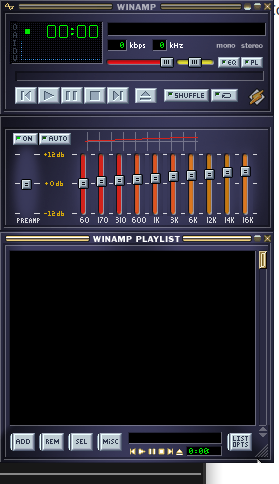
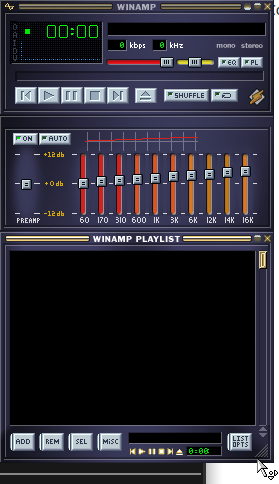
Apps with custom-shaped windows (Winamp-style skins, themed launchers,
kiosk apps) currently have no clean way to display a custom cursor:
- `CursorIcon` is limited to the standard system enum.
- Painting the cursor sprite via `egui::Painter` works inside the canvas
but gets clipped at the window edge — the bottom/right of the cursor
disappears the moment the pointer is near the boundary, and there's no
way to render onto the desktop area exposed by a
transparent/region-shaped window.
`winit` 0.30+ already supports `CustomCursor::from_rgba` +
`ActiveEventLoop::create_custom_cursor`, but `egui-winit` doesn't
surface it. This PR exposes it through egui.
### Visual demonstration
Driving use case: a Winamp WSZ skin player
([all3f0r1/oneamp](https://github.com/all3f0r1/oneamp)) with a
transparent + region-shaped window where the skin ships its own `.cur`
files. The bottom-right corner of the playlist exposes the resize cursor
— notice how it gets clipped at the window edge in the painter-based
approach.
| Before (cursor painted via `egui::Painter`) | After (cursor pushed via
`set_cursor_image`) |
| --- | --- |
| 
| 
|
## API
```rust
// new in egui::data::output
pub struct CustomCursorImage {
pub rgba: std::sync::Arc<[u8]>,
pub size: [u16; 2], // matches winit's u16 to avoid lossy casts
pub hotspot: [u16; 2],
}
// new field on PlatformOutput (skipped from serde — ephemeral)
pub cursor_image: Option<CustomCursorImage>,
// new method on Context
ctx.set_cursor_image(Some(image)); // overrides cursor_icon for this frame
ctx.set_cursor_image(None); // revert to cursor_icon
```
`Arc<[u8]>` is intentional: the integration dedupes by `Arc::as_ptr`, so
reusing the same Arc across frames means the bitmap is only uploaded to
the OS once per skin, not once per frame.
## Integration changes
- `egui_winit::State::handle_platform_output_with_event_loop(window,
Option<&ActiveEventLoop>, ...)` is a new method that threads the active
event loop so it can call `event_loop.create_custom_cursor(...)`.
- The legacy `handle_platform_output(window, ...)` delegates with `None`
and silently drops `cursor_image`. **No existing callers break.**
- The icon and bitmap paths are unified in a private `apply_cursor`. The
no-flicker dedupe of the old `set_cursor_icon` is preserved on both
paths.
- If `CustomCursor::from_rgba` rejects the bitmap (bad dimensions,
hotspot OOB, etc.), we log a warning and fall back to the icon path.
- eframe's wgpu + glow integrations thread `&ActiveEventLoop` through
`run_ui_and_paint` (glow already had it; wgpu needed one extra
parameter) and call the new method.
- Immediate viewports keep the old path because they're invoked from a
`Context` callback that doesn't have an event loop reference. Custom
cursors are a no-op in immediate viewports — acceptable since they're a
niche path.
## Fallback semantics
| backend / context | what happens |
|--------------------------------|-------------------------------|
| eframe wgpu/glow main viewport | bitmap displayed via OS |
| eframe immediate viewport | falls back to `cursor_icon` |
| eframe web | falls back to `cursor_icon` |
| custom integrations not opted in | falls back to `cursor_icon` |
| `from_rgba` returns `BadImage` | warning + falls back to icon |
## Verification
- `cargo fmt --all -- --check` ✅
- `cargo clippy -p egui -p egui-winit -p eframe --all-targets
--all-features -- -D warnings` ✅
- `cargo doc --lib --no-deps -p egui -p egui-winit -p eframe
--all-features` ✅
- `cargo check -p egui --no-default-features --features serde` ✅
(validates the `serde(skip)` on `cursor_image`)
- Interactive validation on Linux/Wayland with the OneAmp WSZ skin
player — see screenshots above.
I haven't run the full snapshot test suite (`scripts/check.sh`) because
we're on Linux and the snapshots are macOS-rendered — happy to run it if
you'd like.
## Notes
Drafted per the contributing guide ("open a draft PR, you may get
helpful feedback early"). Open to design feedback on:
1. Whether `CustomCursorImage` should live in `egui::viewport` rather
than `egui::data::output`.
2. Whether the legacy `handle_platform_output` should grow `event_loop`
directly (breaking) instead of getting a sibling method (non-breaking,
what I did).
3. Whether to also wire it through eframe-web (probably not —
`wasm-bindgen-cursor` would need its own path).
---------
Co-authored-by: Claude Opus 4.7 (1M context) <noreply@anthropic.com>
This lets you start up the test app from within the test itself, which
can be very useful when you have a specific test scenario set up that
you need to debug.

### Related
* Previous attempt: https://github.com/emilk/egui/pull/5418

### macOS
On macOS, you may only run UIs on the main loop, so you need a few
additional steps. Not ideal, but works!


```diff
diff --git a/crates/egui_demo_app/Cargo.toml b/crates/egui_demo_app/Cargo.toml
index f9a153268..4e0cc14ee 100644
--- a/crates/egui_demo_app/Cargo.toml
+++ b/crates/egui_demo_app/Cargo.toml
@@ -84,3 +84,7 @@ web-sys.workspace = true

 [dev-dependencies]
 egui_kittest = { workspace = true, features = ["eframe", "snapshot", "wgpu"] }
+
+[[test]]
+name = "test_demo_app"
+harness = false
diff --git a/crates/egui_demo_app/tests/test_demo_app.rs b/crates/egui_demo_app/tests/test_demo_app.rs
index e083c8455..7ad9ed516 100644
--- a/crates/egui_demo_app/tests/test_demo_app.rs
+++ b/crates/egui_demo_app/tests/test_demo_app.rs
@@ -4,7 +4,10 @@ use egui_demo_app::{Anchor, WrapApp};
 use egui_kittest::SnapshotResults;
 use egui_kittest::kittest::Queryable as _;

-#[test]
+fn main() {
+    test_demo_app();
+}
+
 fn test_demo_app() {
     let mut harness = egui_kittest::Harness::builder()
         .with_size(Vec2::new(900.0, 600.0))
@@ -73,5 +76,8 @@ fn test_demo_app() {
         harness.run_steps(4);

         results.add(harness.try_snapshot(anchor.to_string()));
+
+        harness.spawn_eframe_app();
+        break;
     }
 }
```
This is a breaking public API change, but is otherwise trivial due to it
not changing any actual runtime behaviour.

This renames eframe's NativeOptions `vsync` option to `glow_vsync` to
make clear without even looking at docs fully that this is specific to
the `glow` backend.

While I think a better option would actually be to change the wgpu
creation options to match the vsync option if not specified (either to
`AutoVsync` or `AutoNoVsync` depending on setting) this would require
this be made an `Option<PresentMode>`, which would be confusing - and
the `WgpuConfiguration` should probably take priority over other options
here, as there's more than 2 present modes that are relevant. So I think
this is a suitable way to go.

<!--
Please read the "Making a PR" section of
[`CONTRIBUTING.md`](https://github.com/emilk/egui/blob/main/CONTRIBUTING.md)
before opening a Pull Request!

* Keep your PR:s small and focused.
* The PR title is what ends up in the changelog, so make it descriptive!
* If applicable, add a screenshot or gif.
* If it is a non-trivial addition, consider adding a demo for it to
`egui_demo_lib`, or a new example.
* Do NOT open PR:s from your `master` branch, as that makes it hard for
maintainers to test and add commits to your PR.
* Remember to run `cargo fmt` and `cargo clippy`.
* Open the PR as a draft until you have self-reviewed it and run
`./scripts/check.sh`.
* When you have addressed a PR comment, mark it as resolved.

Please be patient! I will review your PR, but my time is limited!
-->

* This does not close an issue - this was a trivial amount of code to
change, so I might as well just make it a PR on the spot.
* [x] I have followed the instructions in the PR template

---------

Co-authored-by: Emil Ernerfeldt <emil.ernerfeldt@gmail.com>
Enable these new clippy lints and fix all warnings:

* `format_push_string` — use `write!` instead of `s += &format!(…)` to
avoid extra allocations
* `ignored_unit_patterns` — use `()` instead of `_` when matching unit
* `missing_fields_in_debug` — ensure manual `Debug` impls account for
all fields
* `needless_raw_string_hashes` — remove unnecessary `r#` on string
literals
* `ref_option` — prefer `Option<&T>` over `&Option<T>` in function
signatures
When using `egui::ViewportBuilder::with_fullsize_content_view` one must
be careful not to paint anything where the "traffic light" buttons are:

<img width="87" height="47" alt="image"
src="https://github.com/user-attachments/assets/0e878c8e-7141-4fed-bbc8-4d542ddb5251"
/>

`eframe::WindowChromeMetrics` helps you with that!
## Summary
* Closes#5229
* Closes#7776
On Windows, once a window is hidden with
`ViewportCommand::Visible(false)`, two problems occur:
1. **Window can never be shown again** — Windows stops sending
`RedrawRequested` events to invisible windows, and viewport commands are
only processed during `run_ui_and_paint`, which is triggered by
`RedrawRequested`. This creates a deadlock:
```
Visible(false) → window hidden → no RedrawRequested → run_ui_and_paint never called → Visible(true) stuck in queue → window stays hidden forever
```
2. **High CPU usage** — The event loop spins at full speed with
`ControlFlow::Poll` even for invisible windows, and repaint requests are
scheduled immediately, causing a tight loop that burns CPU.
## Fix
**For #5229:** In `check_redraw_requests`, after calling
`window.request_redraw()`, detect invisible windows via
`window.is_visible() == Some(false)` and call `run_ui_and_paint`
directly for them. This ensures pending viewport commands (including
`Visible(true)`) are still processed even when the OS doesn't send
redraw events.
**For #7776:** Three layers of throttling for invisible windows:
- **Heartbeat scheduling:** After painting an invisible window, schedule
the next repaint 100ms in the future (instead of immediately). This
keeps viewport commands flowing while limiting to ~10 repaints/sec.
- **Event throttling:** In `user_event`, throttle `RequestRepaint`
events for invisible windows to at least 100ms delay, preventing egui's
repaint callback from bypassing the heartbeat.
- **ControlFlow fix:** Only set `ControlFlow::Poll` for visible windows.
Invisible windows use `WaitUntil` instead of spinning.
- **Backend sleep:** Add `is_visible() == Some(false)` alongside the
existing `is_minimized()` sleep check in both wgpu and glow backends
(defense in depth).
The fix is platform-agnostic: `is_visible()` returns `Some(false)` only
when the platform can confirm invisibility, so it won't trigger on
platforms where invisible windows still receive `RedrawRequested`.
## Test plan
- [x] `cargo fmt` passes
- [x] `cargo clippy -p eframe --all-features` passes with no warnings
- [x] Manual test on Windows: window reappears after `Visible(true)`
when hidden
- [x] Manual test on Windows: CPU stays near 0% while window is
invisible (was ~16% before fix)
---------
Co-authored-by: Emil Ernerfeldt <emil.ernerfeldt@gmail.com>
* [x] I have followed the instructions in the PR template

This updates wgpu to v29 across the egui crate stack.

There a a few API changes due to the requirement to provide a display
handle up front to properly support GLES on linux. I have done my best
to make the api changes as reasonable as possible, but I don't have all
the greater project context, so lmk if things should be done a bit
differently.

I've also updated glow to 0.17 to make cargo deny happy, there are no
source changes. I'm not sure how you want to land these.

---------

Co-authored-by: lucasmerlin <hi@lucasmerlin.me>
## Summary
- Ignore raw device mouse motion unless the window is focused and the
pointer is inside it
- Also handles pointers starting down and then moving into or out of the
window (drag & drop)
- Prevents global mouse motion from triggering continuous repaint loops
- Applies to both glow and wgpu backends

## Testing
- I ran the check script, nothing seemed to fail

---------

Co-authored-by: Emil Ernerfeldt <emil.ernerfeldt@gmail.com>
<!--
Please read the "Making a PR" section of
[`CONTRIBUTING.md`](https://github.com/emilk/egui/blob/main/CONTRIBUTING.md)
before opening a Pull Request!

* Keep your PR:s small and focused.
* The PR title is what ends up in the changelog, so make it descriptive!
* If applicable, add a screenshot or gif.
* If it is a non-trivial addition, consider adding a demo for it to
`egui_demo_lib`, or a new example.
* Do NOT open PR:s from your `master` branch, as that makes it hard for
maintainers to test and add commits to your PR.
* Remember to run `cargo fmt` and `cargo clippy`.
* Open the PR as a draft until you have self-reviewed it and run
`./scripts/check.sh`.
* When you have addressed a PR comment, mark it as resolved.

Please be patient! I will review your PR, but my time is limited!
-->

* [x] I have followed the instructions in the PR template

`get_proc_address` was introduced in #4145, but its lifetime was
designed to be tied to the lifetime `'s` of `CreationContext`. This
means that using `get_proc_address` outside the lifetime of
`CreationContext` is undefined behavior. This contradicts the original
intent behind introducing `get_proc_address`, as this API is intended
for integration with external libraries that cannot easily guarantee
alignment with egui's lifetimes. This PR changes the type of
`get_proc_address` from a reference to an `Arc`, decoupling its lifetime
from `CreationContext` to achieve safer memory management.
* Part of https://github.com/emilk/egui/issues/5113
* Part of https://github.com/emilk/egui/issues/3524

## What
This deprecates `eframe::App::update` and replaces it with two new
functions:

```rs
pub trait App {
	/// Called just before `ui`, and in the future this will
    /// also be called for background apps when needed.
	fn logic(&mut self, ctx: &egui::Context, frame: &mut Frame) { }

    /// Show your user interface to the user.
	fn ui(&mut self, ui: &mut egui::Ui, frame: &mut Frame);

	…
}
```

Similarly, `Context::run` is deprecated in favor of `Context::run_ui`.

`Plugin`s are now handed a `Ui` instead of just a `Context` in
`on_begin/end_frame`.

## TODO
…either in this PR or a later one
* [x] Deprecate `App::update`
* [x] Deprecate `Context::run`
* [x] Change plugins to get a `Ui`
* [x] Update kittest
* [x] Change viewports to get UI:s (`show_viewport_immediate` etc)
  - https://github.com/emilk/egui/pull/7779

## Later PRs
* [ ] Deprecate `Panel::show`
* [ ] Deprecate `CentralPanel::show`
* [ ] Deprecate `CentralPanel` ?
### What

From the [lint
description](https://rust-lang.github.io/rust-clippy/master/index.html?search=or_fu#or_fun_call):

> The function will always be called. This is only bad if it allocates
or does some non-trivial amount of work.

But also:

> If the function has side-effects, not calling it will change the
semantic of the program, but you shouldn’t rely on that.
>
> The lint also cannot figure out whether the function you call is
actually expensive to call or not.

Still worth it to keep our happy paths clean, imo.
* Part of https://github.com/emilk/egui/issues/5889
* Closes https://github.com/emilk/egui/issues/7106

This changes the `eframe/wgpu` feature to also enable all the `default`
features of `wgpu` and `egui-wgpu`. This makes switching `eframe`
backend from `glow` to `wgpu` a lot easier.

To get the old behavior (depend on `wgpu` but you must opt-in to all its
features), use the new `wgpu_no_default_features` feature.



